Kansas Bureau of Investigation
In Cold BloodThe Kansas Bureau of Investigation is a statewide law-enforcement organization whose role in the investigation of the Clutter family’s deaths grows from a request for specialized help into a sustained, multijurisdictional inquiry. Led in the case by Alvin Adams Dewey, the bureau contributes personnel, coordinated fieldwork, and an insistence on verifiable evidence; its work connects local investigation in western Kansas with leads and suspects encountered far beyond the state.
Statewide Organization and Leadership
The bureau is headquartered in Topeka, Kansas, and has nineteen experienced detectives stationed around the state. Its personnel are available to local authorities when a case appears to exceed their resources. The Clutter investigation brings that statewide function into focus: Earl Robinson, sheriff of Finney County, asks the bureau’s Garden City representative to take charge. Dewey is a fourth-generation Kansan, forty-seven years old, and responsible for a substantial part of western Kansas. Before joining the bureau, he served as Finney County sheriff from 1947 to 1955; earlier, he had been a Federal Bureau of Investigation special agent from 1940 to 1945, working in several cities. His local experience and federal investigative background make him a bridge between the county case and a broader professional network.
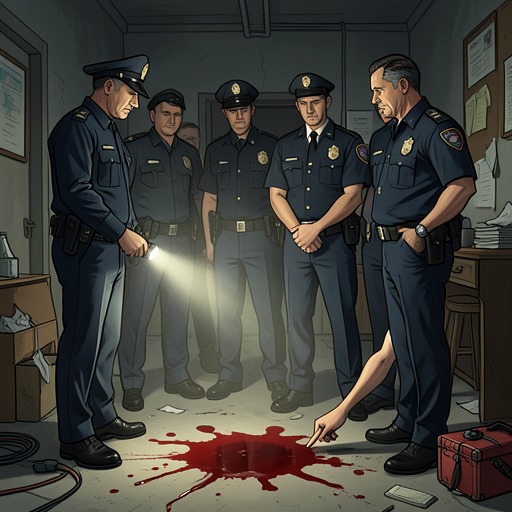
As the investigation expands, the bureau’s work is no longer Dewey’s alone. Special Agents Harold Nye, Roy Church, and Clarence Duntz join him in Garden City, and Dewey regards the group as a strong team. By a later point, eighteen men are assigned to the case full time. That number describes the full investigative effort, not the bureau’s standing staff: the agency’s own statewide complement is nineteen detectives, while the case draws on a wider group of investigators. The distinction conveys both the scale of the inquiry and the way the bureau’s specialists operate alongside other authorities.
Fieldwork, Leads, and Competing Theories
The bureau’s method is presented as patient accumulation rather than an early leap to a single explanation. At a press conference, Dewey separates established information from theory: four people have been killed, but investigators do not yet know which, if any, was the primary target, or the order in which the deaths occurred. He also notes that the coroner can place the murders only within a broad interval, from late Saturday night to early Sunday morning. The limits of what can be known are part of his public account, not a gap concealed by confident speculation.
In private, Dewey considers two possible reconstructions: a single killer with substantial knowledge of the household, or two killers. The first possibility depends on a person’s familiarity with the home and its routines. These remain investigative concepts rather than established conclusions. Dewey resists treating a plausible reconstruction as a solved case, insisting instead that the team must establish a connection between the crime-scene evidence and events in the family’s past. His approach makes the investigation a search for a link, not a contest to produce the most compelling theory.
The agents distribute that search across the community. Church, Duntz, and Nye speak with teachers at the Holcomb school, employees at River Valley Farm, friends, neighbors, and relatives who have arrived for the funeral. The agents also pursue former farm employees and people who had done business with Herbert William Clutter. This canvass reaches beyond immediate witnesses: the team tries to reconstruct a network of work, acquaintance, and ordinary contact that could explain how someone might have learned about the household.
The investigation depends on small discoveries as well as broad interviews. When Nancy Clutter’s clothes are being sorted, her aunt finds a gold wristwatch tucked into the toe of a shoe. At River Valley Farm, Mabel Helm walks through Kenyon Clutter’s room, notices that something is missing, and identifies his small radio as the absence. These discoveries do not, by themselves, identify a suspect. They sharpen the inventory of what happened and give investigators items and circumstances to compare with later information.
Physical Evidence and Investigative Coordination
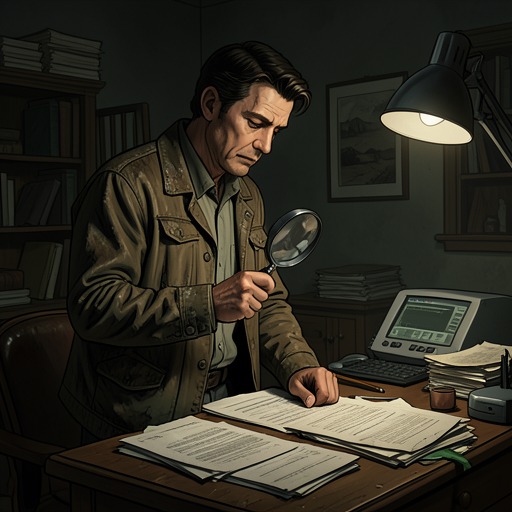
Dewey’s temporary office in the sheriff’s building holds materials that may eventually be presented in court: adhesive tape and lengths of cord removed from the victims, sealed in plastic bags, as well as enlarged crime-scene photographs. The tape and cord are common products, so their presence alone offers limited direction. Their evidentiary value depends on careful documentation and comparison, just as the photographs require close examination rather than an assumption that a revealing detail will immediately appear. The bureau’s approach treats objects as potential evidence whose meaning has to be established.
The agents also follow leads that prove fruitless. Dewey spends two days trying to trace a pair of supposed visitors described by Paul Helm, while the investigators collectively check roughly seven hundred tips and rumors. The episode shows the cost of maintaining a wide search: a lead must be checked even when it may dissolve into misidentification or error. Meanwhile, Alfred Stoecklein’s report of someone inside the Clutter home brings local and state officers, including Dewey and bureau agents, to the scene. A previously unknown man emerges from the house carrying a pistol; the officers secure the weapon and question him. The report draws the investigators into an immediate response, but the man’s presence does not itself establish that he committed the murders.
The bureau’s work later extends to Las Vegas, where four Kansas agents—Nye, Church, Dewey, and Duntz—prepare to confront Smith and Hickock after their arrest. The suspects have signed waivers of extradition, and the team has obtained both pairs of boots. The soles match life-size photographs of footprints from the crime scene. That comparison gives the investigators a concrete connection between the suspects and evidence in the case, rather than relying only on an accusation or an interview account.
The case also involves federal expertise. Four special agents of the Federal Bureau of Investigation, trained as laboratory technicians in different areas of scientific crime detection, examine blood samples, footprints, cartridge shells, rope, and tape, and certify the validity of the exhibits. Their testimony supports the evidentiary record presented by the state. The division of labor matters: the Kansas Bureau of Investigation organizes the regional inquiry and interviews, while federal specialists assess physical materials through laboratory methods. The agencies’ work converges in court without being interchangeable.
Secrecy, Confessions, and the Case in Court
When a major break emerges, Dewey tries to keep it from becoming public. He informs Bill Brown, editor of the Garden City Telegram, and Robert Wells, manager of the local radio station, because he wants to limit the circulation of information while the suspects’ guilt remains unresolved. His stated concern is that the men could be innocent. The decision illustrates an investigative tension: publicity might affect the case, but prematurely treating suspects as guilty would compromise the fairness the investigators must preserve.
Interviews and statements become another part of the bureau’s evidence. Hickock signs a confession in Las Vegas accusing Smith of committing all four murders. Smith later dictates a seventy-eight-page statement to a Finney County court stenographer, recounting admissions he has already made to Dewey and Duntz, but refuses to sign it unless two details are corrected. The difference between an oral account, a signed confession, and a dictated but unsigned statement remains important. Dewey expects to testify about what Smith said; the document’s existence does not erase the disagreement between the two men’s accounts.
Smith’s statement also directs investigators toward additional physical evidence. He describes the pair’s flight from the scene and indicates where they disposed of items. Harold Nye travels to Mexico City and traces a radio and binoculars taken from the Clutter home to a pawnshop. This recovery adds an independent line of inquiry to the confessions: the account of stolen property can be checked against objects located outside Kansas. The book thus presents the case as a cumulative structure in which interviews, recovered property, footprints, and laboratory findings bear on one another, while remaining distinct kinds of evidence.
At trial, the four FBI technicians certify physical exhibits, and Kansas agents recount their interviews and the eventual confessions. Defense attorneys challenge the admissions, alleging that they were obtained through improper interrogation. The prosecution’s case therefore includes not only the content of the statements but also questions about how those statements were obtained. The bureau’s investigative work becomes part of a public legal process in which its methods and evidence are subject to challenge.
Institutional Reach and Narrative Significance
Four bureau agents—Church, Duntz, Nye, and Dewey—later receive permission to attend the executions of Hickock and Smith. Their presence records the long passage from investigation to conviction and punishment, but it should not be mistaken for a separate bureau operation or a claim that every investigator understood the outcome in the same way. Dewey’s response to Smith is notably more complicated than his response to Hickock: although he regards Smith as the principal killer, he also remembers him with a degree of human sympathy. The case leaves its lead investigator with a distinction between professional judgment and personal feeling.
Years later, Dewey remains the bureau’s principal agent in western Kansas. He is still working cases, including cattle rustling, while the hoped-for plan to settle on a farm has given way to a new house in town. That later glimpse gives the organization a continuing presence beyond the Clutter investigation: the bureau is not defined only by its most prominent case, but by ongoing regional work. In the book, its importance lies in the disciplined movement from uncertain leads to corroborated evidence, and in the collective effort that makes a local tragedy answerable to a court.